


We are living through what may be the biggest technological shift since the internet itself: the rise of artificial intelligence (AI). From tools that generate text or images, to companies racing to deploy advanced automation across cloud infrastructure, the pace is breathtaking.
For investors, this technology is more than a novelty — it’s been one of the major drivers behind stock-market returns in recent years. But with great potential comes great uncertainty around how this will all shake out. There are good reasons for optimism, but also very real risks, because much of the current surge is built on hype and large capital expenditures, and not on demonstrated, sustainable profits.
My goal with this post is to simplify what can feel like a complicated topic and highlight a few key things investors need to know:
- What is it (at a high level)?
- Why companies building the chips and infrastructure are leading the charge, but why that may not always be the case.
- Some of the concerns around the current market rally, and risks associated with investing in AI.
- The importance of being diversified and nimble as the AI revolution enters its next phase — especially given how many “first-movers” in prior tech revolutions didn’t end up on top.
What Is AI (High Level) — and Why It Matters
At its core, artificial intelligence refers to computer systems and software that can perform tasks typically requiring human-like intelligence such as understanding language, recognizing images, analyzing data, or making decisions. In recent years, powerful new “generative” models — think large language models, image generators, recommendation systems — have expanded the range of tasks these systems are capable of.
These systems need vast computing power: specialized chips to handle the enormous number of calculations required to train and run artificial intelligence models. That means that behind the “cool software,” there’s a massive underlying infrastructure: data centers, high-performance processors (GPUs or specialized AI chips), energy, and more.
The promise is enticing: if artificial intelligence can truly deliver — automating repetitive tasks, generating insights, improving operations, augmenting creativity — it could transform many industries.
For investors, this means an expectation of future growth, productivity gains, and higher profits for companies that learn to fully leverage these technologies.
Why Chip Makers and Infrastructure Companies are Leading the Charge
Because AI depends so heavily on compute power and infrastructure, a lot of the early gains in the stock market have been concentrated among companies that build the chips and underlying hardware.
- Manufacturers of GPUs and other advanced accelerators have seen surging demand. The “AI arms race” means more demand for data-center hardware.
- Cloud providers and data-center infrastructure firms are scaling up to support these workloads, which often require specialized hardware and lots of electricity.
- Even companies farther along the stack — from software to hosting to operations — are seeing investor interest, betting on integration or delivery of advanced model-driven services. [1]
In many respects, this makes sense: at an early stage, you often get the most traction (and easiest “wins”) from the infrastructure layer — where demand is concrete, scalable, and recurring — rather than from speculative software plays. Think of the businesses selling dungarees and pick-axes during the California gold rush.
To illustrate just how dramatically infrastructure spending has accelerated — and why companies like Nvidia, AMD, Amazon, Microsoft, and Google have dominated stock market performance — consider the chart below from J.P. Morgan Asset Management. It shows both the surge in spending by the AI “hyperscalers” and the explosive growth in semiconductor production since the public launch of ChatGPT.
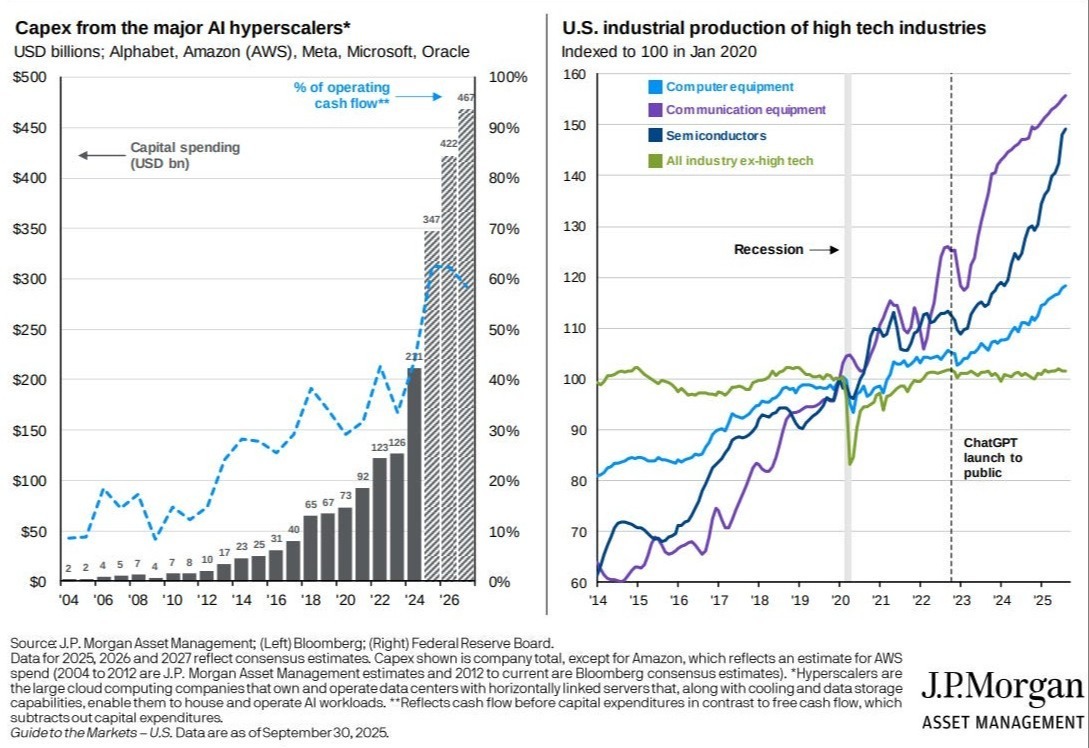
This is exactly why AI-linked companies have been the primary drivers of market returns. The investment boom is unprecedented — but it also raises questions about sustainability, monetization, and the risks of circular spending.
The “Circular Spending” Problem — Why Some Investors Are Nervous
History teaches us that not everything that looks like growth is truly additive. One potential concern being voiced by critics is “circular spending” or a self-reinforcing loop.
Here’s how that’s playing out in the AI world:
Tech giants like Nvidia invest billions in AI startups (like OpenAI) or cloud providers (like CoreWeave), who then use that capital to buy more infrastructure, primarily chips, from the original investors (like Nvidia), creating a closed-loop system. This process boosts revenue for suppliers but raises concerns about inflated growth and an AI bubble, rather than organic demand.
The chart below, from Bloomberg News, highlights this spiderweb of transactions and the massive size and scope of recent deals.
How Nvidia and OpenAI Fuel the AI Money Machine
 Source: Bloomberg News, “OpenAI, Nvidia Fuel $1 Trillion AI Market With Web of Circular Deals” – 10/7/2025
The appearance of booming demand can mask the fact that much of the spending is taking place inside this ecosystem, rather than from widespread real-world customers or end-users. This makes valuations vulnerable if external demand fails to materialize.
Put simply, this could be less about genuine demand and more about companies propping up each other’s valuations through interlocking deals. That creates a fragile foundation if and when the “real world” market for artificial intelligence stalls or slows.
This circularity helps explain some of the volatility we’ve seen recently in AI-related stocks. As soon as doubts emerge — around profitability, scalability, or competitive threats — the bubble of expectations can deflate quickly.
The Big Question: Will Massive Capital Expenditure Actually Pay Off?
Here’s the trillion dollar question — and what every investor should keep in mind: we don’t yet have strong, generalized evidence that this massive wave of capital expenditure will deliver broad, sustainable returns for companies or investors.
- According to a recent report out of the MIT Media Lab, many automation and digital transformation initiatives have failed to deliver expected returns. The study found that despite $30-40 billion in enterprise spending on generative AI, 95% of organizations are seeing no business return.[2]
- In practice, many companies that rushed to deploy AI failed to see transformative improvements because they didn’t first rework their underlying business processes. In other words: you can’t just bolt new technology onto a business — you need organizational change, training, revised workflows, and process optimization for artificial intelligence to actually deliver value.[3]
All of this suggests that we may be in the early innings of this massive technological build-out. The infrastructure (chips, data centers, cloud services) may be scaling rapidly — but how or when that leads to widespread, profitable deployment of AI across industries is still very uncertain.
The Second Wave: Where the Next Winners May Come From
But the story isn’t all pessimism. In fact, one of the most compelling reasons to be optimistic, and diversified, is that artificial intelligence’s ripple effects could lift many industries — not just chip makers and cloud providers.
For example:
- The rapid growth in AI compute demand is already putting stress on power grids — especially in regions where data centers cluster. That means companies involved in power generation, grid infrastructure, energy distribution, and related utilities could see meaningful demand.[4]
- Industries that adopt these tools effectively — not just the flashy “chatbot or image generator” companies, but firms that use artificial intelligence to optimize logistics, manufacturing, supply-chain, operations, forecasting, customer service, and more — could reap long-term productivity gains. Those gains will often come not from hiring a fancy AI vendor, but from rethinking business processes and integrating intelligent systems thoughtfully.
- Over time, as narrow (specialized) models proliferate — not just generalized foundational models — we may see productivity gains across healthcare, manufacturing, energy, logistics, retail, enterprise operations, etc. In other words: the artificial intelligence wave could be less about a handful of “AI companies” and more about the modernization of many industries.
So for long-term investors, there’s a case to participate in the broader “AI build-out” — not by chasing hype, but by identifying players likely to benefit if adoption becomes widespread: infrastructure, utilities, companies investing in internal artificial intelligence deployment, and industries undergoing digital transformation.
A Historical Reminder: Stay Nimble and Stay Diversified
One of the clearest lessons from prior technology revolutions (personal computing, the internet, mobile) is this: many of the first — or flashiest — companies did not end up as the long-term winners (AOL, MySpace and Blackberry are a few that come to mind).
The early boom often leads to overvaluation, then shakeouts, consolidation, and only a few durable winners will remain because building lasting businesses requires far more than a good idea or early hype.
It demands:
- Sustainable business models
- The ability to monetize, not just launch
- The capacity to adapt and evolve — markets, regulations, competition, and consumer behavior all shift
- Diversification, not over-concentration in a single theme or trend
In the current AI cycle, that lesson is especially relevant. “Circular spending” — while tempting for quick growth — is fragile if the broader economy doesn’t adopt these tools at scale, or if they fail to deliver commensurate value.
As some risk-management experts argue, many AI initiatives may fail not because the technology is bad — but because companies treat it as a plug-in, rather than as part of a thoughtful, holistic organizational transformation.[5]
While We're Still At The Beginning Of This Innovation Cycle
I believe we are still in the early innings of the AI buildout.
Here’s why — and what might trigger the next major wave:
- Infrastructure is still scaling. We are building the hardware — chips, data centers, networks, and energy supply. But that’s just the foundation.
- Most companies are not yet realizing value. Many enterprise initiatives still haven’t delivered expected returns. Valuations remain anchored to potential, not performance.
- Enterprise disruption takes time. For AI to transform an industry — operations need to be reworked, processes optimized, and people trained. That takes planning, organizational change, and time.
- Non-tech industries may be the real sleeper winners. As automation and advanced analytics become more integrated, industries like energy, logistics, manufacturing, utilities, and infrastructure may see outsized gains — especially those that invest early in adapting to demand.
If I’m right, the next leg won’t necessarily be led by the biggest “AI companies.” Instead, it may be driven by more mundane — but critical — infrastructural and operational winners.
What This Means for Investors
Let's summarize these themes into some important concepts that investors should keep in mind when thinking about investing in artificial intelligence companies:
1. Recognize the opportunity — but treat it with humility.
AI has the potential to transform many industries. The infrastructure layer has already seen strong growth. But potential isn’t the same as proof. Be excited, but cautious.
2. Focus on fundamentals, not just narrative.
When evaluating investment opportunities, ask hard questions: Do these companies have a plan to monetize? Are they reworking business processes to take advantage of artificial intelligence? Is their competitive advantage durable?
3. Diversify broadly — including outside “pure tech.”
Given how uncertain the ultimate winners will be, you don’t want all your eggs in chipmakers or artificial intelligence startups. Consider companies in sectors like energy, infrastructure and utilities, or companies outside of tech that are well-positioned to benefit from AI adoption.
4. Be nimble — stay alert to shifts in the cycle.
The history of technology shows that big winners often emerge after the hype - sometimes from unexpected places. What’s “hot” today may not be tomorrow. Be patient and recognize that investors that play the long game often reap the greatest rewards.
5. Have a long-term horizon — and expect turbulence.
Even if AI delivers, it likely will unfold over many years. Expect volatility. Don’t panic at dips, but don’t chase every surge either.
Investing in AI: The Value of Having a Guide
As exciting as this new wave of artificial intelligence is, it can also feel like a lot to sort through. New companies, new technologies, new promises — and a lot of uncertainty mixed in. Figuring out how all of this fits into your own financial life isn’t always straightforward.
Investing in AI isn’t just about picking the right stocks. It’s about making sure these investments are part of a diversified portfolio and a broader financial plan that’s right for you. That means considering things like how much risk you can take, how much income you’ll need in retirement, how taxes may affect you, and what your long-term goals look like.
Without that bigger picture, it’s easy to get swept up in the excitement of emerging technology without understanding how it affects the rest of your financial life.
That’s where having someone in your corner can be helpful. At Compass Financial Group, we work with our clients every day to connect these kinds of decisions back to what truly matters to them.
If you’re looking for a thoughtful, down-to-earth conversation about how investing in AI — or any other trend — can fit into your portfolio and your retirement plan, we’d be glad to talk and see how we can help. Click here to get your Free Retirement Assessment.
Sources
[1] Tyler Roush, “Nvidia’s $2 Billion Synopsys Investment Makes 2025’s Top AI Deals” – 12/1/2025 (Forbes)
[2] David Ramel, “MIT Report: Most Organizations See No Business Return on Gen AI Investments” – 8/26/2025 (Campus Technology)
[3] António Costa, “Why AI Fails Without Streamlined Processes - And 3 Ways to Unlock Real Value” – 8/6/2025 (World Economic Forum)
[4] Raghu Madabushi, “AI Energy Demand Means Innovation Must Crackle in an Unlikely Place: Electric Utilities” – 2/20/2025 (Fortune)
[5] Martin Mocker and Joe Peppard, “Why It’s Safe To Bet That Most Companies Will Not Benefit From AI Investments” – 11/10/2025 (California Management Review)
Disclosures
The opinions voiced in this material are for general information only and are not intended to provide specific advice or recommendations for any individual.
Any company names noted herein are for educational purposes only and not an indication of trading intent or a solicitation of their products or services.
All investing involves risk including loss of principal. No strategy assures success or protects against loss. There is no guarantee that a diversified portfolio will enhance overall returns or outperform a non-diversified portfolio. Diversification does not protect against market risk.