


The $40 Trillion Question: What America’s Rising Debt Could Mean for Investors
The United States recently crossed a milestone that is difficult to comprehend: more than $40 trillion in total federal debt.
Numbers that large naturally produce unsettling questions. Can the government continue borrowing at this pace? Could the debt trigger a financial crisis? Will taxes have to rise? Will inflation remain elevated? And, perhaps most importantly for investors, what could this mean for their portfolios?
There are no simple answers. If you’ve been looking at our national debt lately and wondering, “How on earth do we fix this?” — you are not alone. Many investors I speak with are asking that exact question and feeling understandably nervous about what comes next. In today’s post, I’m tackling these questions head-on, breaking down the possible paths forward and their implications for investors.
A large national debt does not automatically cause the economy or stock market to collapse. But it can influence interest rates, inflation, the value of the dollar and the types of investments that perform well.
Understanding the risk begins with understanding what the $40 trillion figure actually represents.
Debt and Deficits Are Not the Same Thing
The national debt is the accumulated amount the federal government has borrowed over many years.
The deficit is the amount the government adds to that debt during a particular year because it spends more than it collects in taxes and other revenue.
One way to think about the difference is to compare the federal government with a household:
- The debt is similar to the balance accumulated on a credit card.
- The deficit is the amount added to that balance this year because spending exceeded income.
It’s important to remember that total federal debt includes both debt held by the public—Treasury securities owned by investors, banks, pension funds, the Federal Reserve and foreign governments—and intragovernmental debt held by federal trust funds and other government accounts.
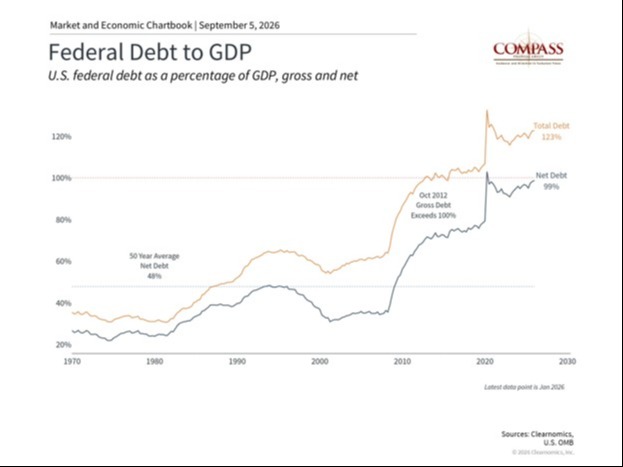
In the chart below, gross debt represents total federal debt, including debt held within the government, while net debt corresponds with debt held by the public.
Debt held by the public is generally the more useful measure when assessing the debt’s effect on the economy and financial markets. The chart places net debt at approximately 99% of GDP as of January 2026. CBO projects that debt held by the public will equal approximately 101% of GDP for fiscal year 2026.
As a point of comparison, debt held by the public (net debt) reached a previous record of approximately 106% of GDP immediately after World War II. CBO projects that it will surpass that record by 2030 and reach approximately 120% of GDP by 2036 under current law.
How Did the Debt Become So Large?
At the end of fiscal year 2016, total federal debt stood at approximately $19.6 trillion. By the end of 2021 it had reached $28.4 trillion and by August 2026, it had exceeded $40 trillion. The total has roughly doubled over the past decade.
Several forces produced that increase:
- Emergency spending and lost revenue during the 2008 financial crisis and the COVID-19 pandemic
- Persistent deficits during otherwise normal economic periods
- The growing cost of Social Security, Medicare and other mandatory programs
- Tax and spending policies that have not produced enough revenue to cover federal commitments
- Rising interest expense as older, lower-rate debt matures and is refinanced at higher rates
That final item is especially important. Debt comes with an interest expense, and interest expense contributes to future deficits, which require still more borrowing.
CBO projects the interest on the debt to be more than $1 trillion in 2026, rising to approximately $2.1 trillion by 2036. Interest already exceeds annual federal defense spending, which is running at roughly $900 billion. As hard as it may be to believe, the government is expected to spend more this year paying the interest on its debt than it spends on national defense.
Does This Eventually Become “Bad” for the Economy or Markets?
Potentially—but not necessarily through the sudden crisis that many seem to be worried about.
The United States has an important advantage: It borrows primarily in its own currency, and the dollar remains the world’s principal reserve currency. Unlike a household, or a company or country that owes debt in a foreign currency, the United States is unlikely to run out of the currency needed to repay its obligations. In an extreme situation, the Federal Reserve could create additional dollar reserves and purchase Treasury securities, making it easier for the government to finance its debt.
That does not make the debt cost-free. Creating more dollars to support government borrowing could contribute to inflation, weaken the dollar and allow the debt to be repaid with money that has lost purchasing power.
Large deficits require the Treasury to issue more securities (borrow more money). Investors may demand higher yields (interest rates) to absorb that supply, particularly if they become concerned about inflation or fiscal policy. Higher Treasury yields can raise borrowing costs throughout the economy, including mortgage rates and the cost of financing businesses.
Higher yields can also place pressure on stock valuations. When relatively safe bonds offer more attractive returns, investors may be less willing to pay very high prices for stocks—especially growth companies whose expected profits may lie many years in the future.
In my view, the more probable long-term risk is neither an immediate default nor a dramatic market collapse. It is an extended period in which policymakers tolerate higher inflation and attempt to hold down long-term interest rates to prevent government borrowing costs from rising as much as they otherwise would.
The Government’s Three Broad Choices
Historically, governments dealing with an excessive debt burden have relied on some combination of three approaches:
- Austerity
Austerity means reducing deficits through spending cuts, tax increases or both.
This is the most direct solution mathematically, but often the most difficult politically. Much of the federal budget consists of Social Security, Medicare, defense and other programs with large and committed constituencies.
Closing a multi-trillion-dollar annual shortfall would likely require some combination of spending reductions and higher revenue, with potentially significant effects on households, businesses and economic growth. Even if Congress adopts tax increases and spending cuts, closing a gap of this size through austerity alone would be extremely difficult. - Default or Restructuring
A government can reduce its debt by failing to repay creditors in full, delaying payments or restructuring what it owes.
For the United States, an intentional economic default appears unlikely. Treasury securities underpin global banking, collateral and payment systems, and a default could severely damage the country’s financial standing.
That does not eliminate the possibility of a technical default caused by political conflict over borrowing authority, but it does mean that an outright refusal to honor Treasury obligations is probably the most disruptive—and therefore least attractive—of the available choices. - Financial Repression
Most investors are probably familiar with the first two options, but the third is less commonly discussed.
Financial repression is a government policy playbook for managing and gradually inflating away debt that has become difficult to address through taxation and spending cuts alone. Instead of explicitly defaulting, policymakers work to keep government borrowing costs below inflation. This reduces the debt’s real, inflation-adjusted value over time.
Suppose the government pays an average interest rate of 3% on its debt while inflation runs at 4%. Bondholders receive every dollar they were promised, but the purchasing power of those dollars declines by approximately 1% per year. The government benefits because it repays its obligations with dollars that are worth less than the dollars it originally borrowed.
Financial repression played an important role in reducing government debt after World War II. Research published by the International Monetary Fund describes it as an implicit tax on bondholders and savers created through “negative” real interest rates. In the United States, the real return on government debt was negative in nearly half the years from 1945 through 1980.
How Could Policymakers Hold Down Borrowing Costs?
Financial repression would probably emerge through a pattern of policies rather than an official announcement.
For example, imagine inflation remains at 3.5%, well above the Federal Reserve’s 2% target. Instead of keeping rates high until inflation returns to target, the Fed might stop raising rates or begin cutting them—essentially easing its foot off the economy’s brakes.
Lower rates could support the economy and reduce government borrowing costs, but they could also allow inflation to remain elevated. If this became a sustained pattern, investors might interpret it as a willingness to tolerate additional inflation rather than risk the economic and fiscal consequences of higher rates.
If longer-term Treasury yields continued rising, the Federal Reserve could purchase Treasury securities to create demand and restrain those yields. In a more explicit form known as yield-curve control, it could establish a ceiling for a particular Treasury yield and buy enough bonds to defend it.
Financial repression can also employ “captive buyers.” Banking, insurance and pension regulations may encourage institutions to hold government securities even when their expected returns are unattractive after inflation.
Possible signs of a developing repression regime could include:
- Inflation remaining above target while the Federal Reserve stops raising rates or begins cutting them
- Treasury yields remaining below inflation for an extended period
- Large or recurring Federal Reserve purchases of Treasury securities
- Policies intended to cap or suppress longer-term yields
- Regulatory changes that encourage institutions to hold more government debt
- Growing political pressure on the Federal Reserve or greater coordination between the Fed and Treasury
- An apparent willingness to tolerate a weaker dollar
No single action would prove that financial repression was underway. The stronger evidence would be a sustained pattern in which policymakers tolerate above-target inflation while acting to keep government borrowing costs below it.
The Debasement Trade: The Market’s Defensive Response
If financial repression is the government’s policy playbook, the debasement trade is the market’s defensive response.
Holding interest rates below inflation reduces the real value of the government’s debt, but it also reduces the purchasing power of the dollar. In this case, the interest you earn in a traditional bank account or a safe government bond can no longer keep up with inflation.
If investors expect those conditions to persist, investors may conclude that cash and traditional government bonds are unlikely to preserve their wealth after inflation. They may begin moving capital toward assets viewed as better stores of purchasing power—a market response commonly called the debasement trade.
Consider an investor holding a long-term Treasury bond yielding 3% while inflation is 4%. If those conditions persist, the bond produces income but loses purchasing power. The investor might respond by moving some capital toward assets whose supply cannot easily be increased by policymakers.
That does not mean all investors abandon Treasury securities. Treasuries still provide income, liquidity and potential protection during economic downturns. Banks, pension funds and other institutions may also continue to own them because of regulatory requirements or portfolio obligations.
The debasement trade occurs at the margin, as some independent investors reduce their reliance on cash and long-term bonds and favor scarce or tangible assets. Investments commonly associated with this response include:
- Gold and other precious metals
- Commodities
- Natural-resource, mining and energy companies
- Certain real estate and infrastructure assets
- Inflation-protected securities
- Foreign investments that may benefit from a weaker dollar
- Businesses with pricing power and durable cash flows
Bitcoin and other digital assets are also sometimes included in this group because they have limited supply, but their short histories and extreme volatility make them less established as inflation or currency hedges than traditional hard assets.
The theory is straightforward: Policymakers can create more dollars, issue additional government debt and influence interest rates. They cannot easily create additional gold, farmland, energy reserves or other scarce resources.
What Could This Environment Mean for Investors?
Financial repression would create different challenges and opportunities across financial markets.
For investors, the objective is not to predict exactly what policymakers will do, but to understand how different parts of a portfolio could respond if inflation remains above interest rates and the dollar loses purchasing power.
Traditional long-term bonds could be particularly vulnerable because inflation erodes the purchasing power of their fixed payments. Cash and savings accounts face the same risk when their yields remain below inflation—an especially important consideration for retirees who may depend on these assets for spending.
Highly valued growth stocks could also face pressure if inflation keeps longer-term interest rates and investor discount rates above the unusually low levels that prevailed before 2020. Many growth-oriented companies—including some technology companies—derive much of their current value from profits expected far in the future. A higher discount rate reduces what those future profits are worth today, potentially causing the stock price to fall even if the company’s long-term business outlook has not changed.
Hard assets, natural-resource companies and businesses with pricing power may do well if investors become concerned about the dollar’s purchasing power. Unhedged foreign investments may also benefit from a weaker dollar, while inflation-protected and shorter-term bonds may be less exposed to some of the risks facing long-term bonds.
These are economic relationships, not predictions or recommendations. Gold can fall during inflationary periods, commodities can decline during recessions, real estate is sensitive to financing costs, and foreign investments carry their own currency and political risks. No asset provides guaranteed protection.
The Bottom Line: Two Sides of the Same Process
Financial repression and the debasement trade describe two sides of the same process.
When a government’s debt becomes too large to address easily through taxation and spending restraint, policymakers may attempt to reduce its real value by holding borrowing costs below inflation.
That is financial repression.
If investors recognize that cash and bonds are producing persistently negative inflation-adjusted returns, some may move capital toward scarce assets that are more difficult for policymakers to create or control.
That is the debasement trade.
In simple terms:
- Financial repression is the government’s attempt to manage and inflate away the debt.
- Currency debasement is a potential consequence of that policy.
- The debasement trade is the market’s attempt to defend against the loss of purchasing power.
None of this means financial repression is inevitable or that any particular investment will benefit. Policymakers could adopt meaningful fiscal reforms, inflation could decline, or stronger productivity and economic growth could improve the country’s finances.
An abrupt default or financial crisis is possible, but it is not the only—or necessarily the most likely—outcome. The adjustment could instead unfold over many years, through persistent inflation, artificially suppressed interest rates and declining purchasing power.
The $40 trillion milestone does not tell us which path the government will choose. But it makes the relationship among debt, inflation, interest rates and purchasing power increasingly important to understand.
My concern is therefore not simply the size of the debt. It is the growing likelihood that policymakers will eventually choose inflation and artificially restrained borrowing costs as the least disruptive way to manage it.
The debt may be measured in dollars, but for investors, its ultimate impact will be measured in real purchasing power.
Sources
- Congressional Budget Office, Monthly Budget Review: July 2026: https://www.cbo.gov/publication/61983
- Congressional Budget Office, The Budget and Economic Outlook: 2026 to 2036: https://www.cbo.gov/publication/62105
- Congressional Budget Office, Director’s Statement on the Budget and Economic Outlook for 2026 to 2036: https://www.cbo.gov/publication/62050
- U.S. Treasury Fiscal Data, America’s Finance Guide: https://fiscaldata.treasury.gov/americas-finance-guide/
- International Monetary Fund, The Liquidation of Government Debt: https://www.imf.org/-/media/websites/imf/imported-full-text-pdf/external/pubs/ft/wp/2015/_wp1507.pdf
This article is intended solely for educational purposes and should not be interpreted as individualized investment, tax or legal advice. References to asset classes describe potential economic relationships rather than recommendations. Actual investment outcomes depend on individual circumstances and market conditions, and all investments involve risk, including the possible loss of principal.
Bonds are subject to market and interest rate risk if sold prior to maturity. Bond values will decline as interest rates rise and bonds are subject to availability and change in price.
The fast price swings in commodities will result in significant volatility in an investor’s holdings. Commodities include increased risks, such as political, economic, and currency instability, and may not be suitable for all investors